
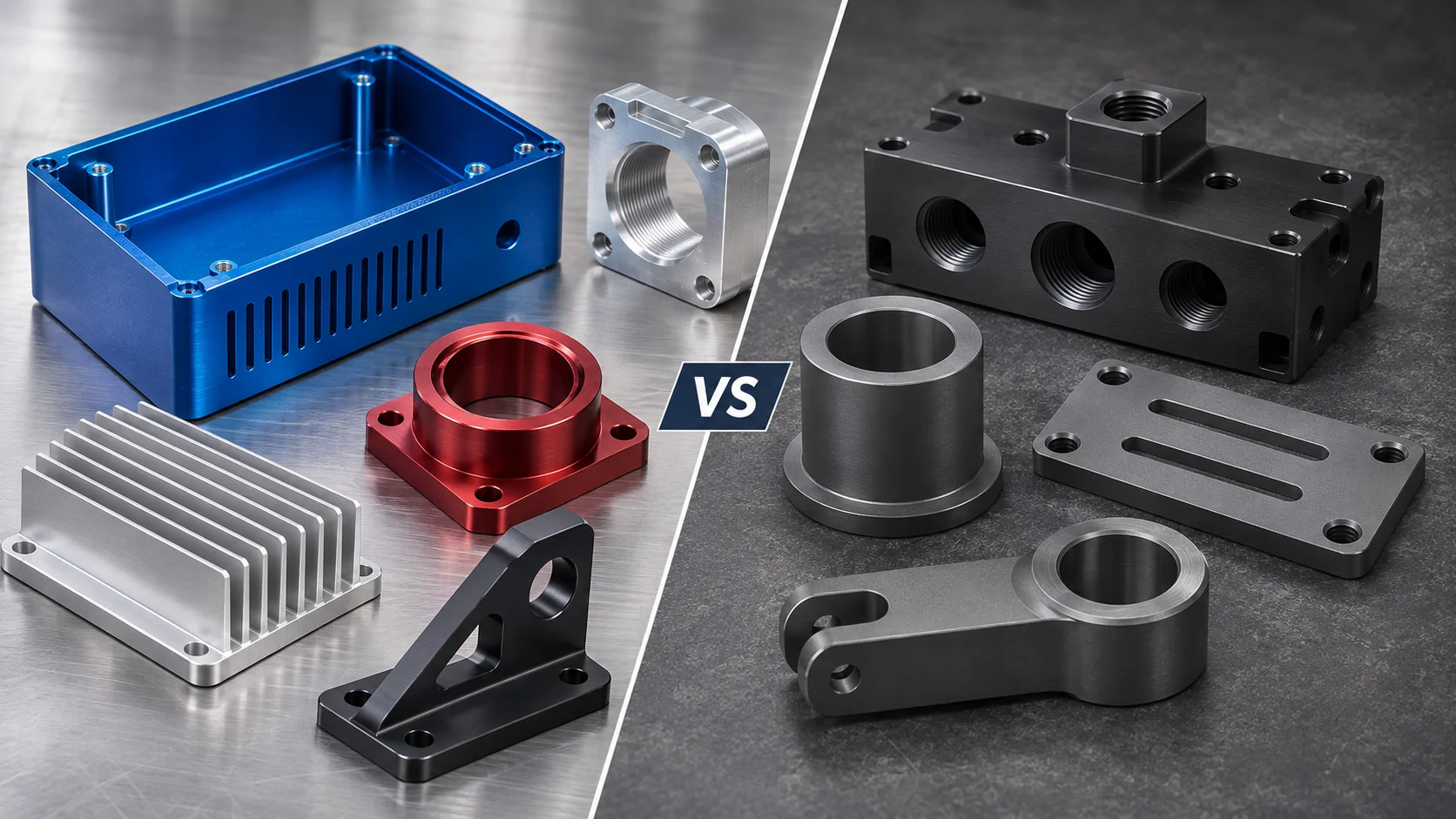
Quick answer: Type II anodizing is generally selected for corrosion protection and colour flexibility, while Type III hard anodizing is designed for increased hardness and wear resistance. Both processes have advantages, but the correct choice depends on the component's function, operating environment, and dimensional requirements. The engineering drawing and applicable specification should always guide the final selection.
Introduction
An aluminum component with tight-fitting threads, a housing that requires a specific colour, and a hydraulic part exposed to repeated wear may all require anodizing. However, the requirements of each component can lead to different decisions about the appropriate coating.
For engineers and manufacturers, understanding the differences between Type II and Type III anodizing is important when selecting a finish that meets performance requirements, maintains dimensional tolerances, and provides the appropriate level of corrosion and wear resistance.
This article explores the key differences between Type II sulphuric anodizing and Type III hard anodizing, their typical applications, and the factors manufacturers should consider when specifying the appropriate finish.
What is Anodizing
Anodizing is an electrochemical process that converts the surface of aluminum into a protective aluminum oxide layer. Unlike paint or other applied coatings, the anodic layer forms from the aluminum itself.
The resulting coating improves corrosion resistance, provides electrical insulation, and can increase surface durability. Its characteristics depend on factors such as the aluminum alloy, coating thickness, processing conditions, and sealing requirements.
Different anodizing processes are used to achieve different coating properties. The military specification MIL-PRF-8625 for example, identifies several types, including Type I chromic acid anodizing, Type II sulphuric anodizing, and Type III hard anodizing.
At West-Tech Finishing, we offer Type II and Type III, which are compared in the following sections.
Type II Sulphuric Anodizing: Protection With Colour Flexibility
Type II anodizing uses a sulphuric acid electrolyte to create a protective oxide coating. It is commonly specified when corrosion resistance, surface appearance, and colour consistency are important.
Because the coating can absorb dyes before sealing, manufacturers can select finishes that meet both functional and visual requirements.
West-Tech Finishing offers Type II sulphuric anodizing in the following finishes:
- Clear (Class 1): Undyed.
- Black (Class 2): Dyed.
- Blue (Class 2): Dyed
- Red (Class 2): Dyed.
- Gunmetal (Class 2): Dyed.
These finishes are processed to MIL-A-8625 / MIL-PRF-8625 Type II, Classes 1 and 2. Final shades can vary depending on the alloy, original surface finish, and coating thickness.
Typical applications include electronic enclosures, automotive components, equipment housings, and aluminum parts requiring corrosion protection or a specified appearance.
Type II is not exclusively decorative. It provides functional protection and is often suitable for components that do not require the higher abrasion resistance of a hardcoat.
Type III Hard Anodizing: Built for Demanding Conditions
Type III, commonly called hardcoat anodizing, is engineered primarily for durability. Compared with conventional Type II processing, it generally uses colder bath temperatures and higher current densities to develop a thicker, harder oxide coating.
West-Tech Finishing offers Type III hard anodizing in two finishes:
- Hard Clear (Class 1): Undyed.
- Hard Black (Class 2): Dyed.
These finishes are processed to MIL-A-8625 / MIL-PRF-8625 Type III, Classes 1 and 2.
Hardcoat is commonly specified for hydraulic components, valve bodies, pistons, sliding surfaces, and industrial machinery where wear resistance is a priority.
Unlike Type II, Type III offers more limited colour flexibility. Natural hardcoat appearance can range from grey to darker shades depending on the alloy, surface condition, and coating thickness. Hard clear should not be interpreted as a colourless finish.
Sealing also requires consideration. MIL-PRF-8625 advises against sealing Type III coatings when maximum abrasion resistance is the primary objective, unless dyed colour or corrosion protection is also a requirement. Sealing can improve corrosion resistance but reduce wear resistance.
A thicker coating is not automatically the better choice. The part's function and dimensional requirements should determine the specified thickness.
Type II vs. Type III: Key Differences
| Feature | Type II | Type III |
|---|---|---|
| Primary priority | Improve corrosion resistance, surface protection, and appearance. It provides a durable protective coating while allowing manufacturers to achieve different colours and finishes. | Designed for components requiring greater surface hardness, abrasion resistance, and durability. Its thicker oxide layer is beneficial for parts exposed to friction, repeated contact, and demanding operating conditions. |
| West-Tech coating range | 0.0003–0.001 inches. Produces a relatively thin protective oxide layer. | 0.001–0.003 inches. Produces a thicker, harder oxide layer that improves wear resistance. |
| Available West-Tech Finishes | Clear, Black, Blue, Red, and Gunmetal. | Hard Clear and Hard Black. |
| Typical Applications | Commonly used for electronic enclosures, automotive components, equipment housings, and other aluminum parts requiring corrosion protection, a consistent surface finish, or a specific colour. | Commonly specified for hydraulic components, valve bodies, pistons, industrial machinery, and sliding or bearing surfaces where increased hardness and resistance to repeated wear are important. |
| Key Design Factors | Colour consistency, surface appearance, coating thickness, corrosion protection, and sealing requirements. Alloy selection and surface preparation can also influence the final appearance. | Dimensional tolerances, coating buildup, wear requirements, and masking of critical surfaces. Threads, bores, and precision mating surfaces may require protection to maintain the intended fit. |
These are application guidelines rather than absolute rules. The drawing, service environment, and applicable specification should determine the final selection.
Getting the Drawing Callout Right
Anodizing requirements should be identified clearly on the engineering drawing or purchase documentation.
MIL-PRF-8625 superseded the older MIL-A-8625 designation, although many drawings still reference MIL-A-8625. Both names refer to the same anodic-coating specification family, but the applicable revision must be confirmed.
For Type II and Type III, the drawing should identify the process type, coating class, required thickness where applicable, colour, and any areas requiring masking.
Example drawing callout — format reference only:
Anodize per MIL-PRF-8625, Type III, Class 1, 0.002" thick. Mask all threads.
This example illustrates how requirements may be communicated. It is not a recommendation for a particular component.
Clear drawings reduce ambiguity around coating thickness, dimensions, and which surfaces should remain untreated.
How to Choose the Right Anodizing Process
Choose Type II if…
- Corrosion protection and surface appearance are the main priorities.
- The component requires a specific dyed colour.
- The application does not require the additional wear resistance of Type III.
Choose Type III if…
- The component is exposed to repeated friction, sliding contact, or abrasion.
- Greater surface hardness and wear resistance are required.
- The design allows for thicker coatings and associated dimensional changes.
Talk to us first if…
- The part has tight tolerances, precision bores, threads, or mating surfaces.
- The application requires both corrosion protection and high wear resistance.
- Certain surfaces must remain electrically conductive.
- The alloy, coating thickness, or finish requirements are unclear.
Frequently Asked Questions
Does anodizing change the physical dimensions of a part?
Yes. Anodizing converts part of the existing aluminum surface into oxide while also creating outward buildup.
For example, a 0.002-inch Type III coating may create approximately 0.001 inch of outward growth on each coated surface. Across two opposing external surfaces, the overall dimension could increase by about 0.002 inch.
This matters for threads, bores, mating faces, and precision fits. Designers should identify critical dimensions on drawings and specify masking or machining allowances where needed.
Which aluminum alloy grades yield the best results?
There is no single best alloy for every application, but 6061 and 6063 are strong general choices because they typically anodize consistently. 5052 and 5005 can also produce good finishes, particularly for applications emphasizing corrosion protection or appearance.
Higher-copper alloys, including 2024, can be more challenging and may produce darker or less uniform coatings. High-silicon casting alloys can also affect surface appearance.
The best alloy depends on the part's mechanical requirements and the intended anodized finish. Confirm the alloy and temper before specifying the process.
Why can't Type III (hardcoat) parts be dyed vivid or bright colours?
Type III coatings can be dyed, but achieving bright, consistent colours is more difficult than with Type II.
Hardcoat coatings are typically thicker and have their own natural colouring, which can range from grey or bronze to darker shades. This underlying colour can interfere with dyes and make vivid colours difficult to reproduce consistently.
For applications requiring bright cosmetic colours, Type II is generally the more suitable choice.
What could happen if you didn’t anodize a part
Think of untreated aluminum like a smartphone without a case. It already has a natural layer of protection, but that protection has its limits.
Aluminum naturally forms a thin oxide layer that helps resist corrosion. However, when exposed to harsh environments, repeated friction, or everyday wear, this natural protection may not be sufficient. Over time, components can experience surface deterioration, increased wear, and changes in appearance.
Anodizing provides an additional level of protection by creating a thicker, more durable oxide layer. However, not every aluminum component requires anodizing. The decision ultimately depends on the part's intended application, operating environment, and performance requirements.
Precision Finishing at West-Tech
At West-Tech Finishing, we understand that every component has its own requirements. Our goal is to help customers find the right finishing solution while delivering the quality, consistency, and reliable service they expect.
Whether you're working with tight dimensional tolerances, specific coating requirements, or a demanding production schedule, we're here to help you find the right approach for your project.
With nearly 40 years in the metal finishing industry, West-Tech is NADCAP accredited, certified to AS9100 Rev D and ISO 9001:2015, and registered under the Controlled Goods Program.
We understand the importance of keeping production moving. That's why our standard lead time is 4–5 business days, with expedited services available when timelines are tight.
Have a project in mind? Send us your drawings and finishing requirements. Even if you're unsure which process is right for your components, we're happy to discuss your options and help you move forward with confidence.
📩 Email: webquery@westtech.ca
🌐 Website: https://westtech.ca/